This guide delivers over 75 ready-to-use conversation starters organized by context, plus three original frameworks you won't find on competitor sites. Key takeaways:
- The Digital FORD Technique: An original 4-step framework (Familiarity, Observations, Recreation, Distractions) adapted from classic networking specifically for anonymous chat rooms and private DMs.
- Digital Body Language: How to read typing indicators, response times, and punctuation as social signals to gauge interest and pace the conversation correctly.
- Conversational Threading: How to link topics seamlessly so chats never hit a dead end — without interrogating the other person.
Most people open with "hey" — and get "hey" back, then silence. The difference between a conversation that dies in two exchanges and one that lasts an hour isn't luck. It comes down to one thing: your first message either gives the other person something to respond to, or it doesn't.
Online chat strips away the context that face-to-face conversation relies on — shared environment, body language, vocal tone. When you meet someone in person, the room itself gives you material: the weather, the music, the line you're standing in. On a blank chat screen, you have to create that context yourself. That's why generic openers like "what's up?" or "how are you doing?" consistently fail: they place the entire conversational burden on a stranger who has no reason yet to do that work for you.
This guide gives you a structured system instead of hoping for inspiration. The openers below are organized by platform and intent, so you can grab exactly what fits your situation — not a one-size-fits-all list that treats Tinder the same as a Discord server.
What Is a Conversation Starter?
Definition: A conversation starter (or icebreaker) is a specific phrase, question, or observation designed to initiate meaningful dialogue between two or more people. In an online setting, effective conversation starters bypass dead-end small talk by using "Curiosity Hooks" — phrases that make a one-word reply feel insufficient. The goal is to demand elaboration, build instant rapport, and give the other person a reason to invest in the exchange.
Why Online Icebreakers Feel Awkward (And How to Fix It)
To understand what makes conversation starters work, you first need to understand why they feel unnatural in digital spaces. Online chatting lacks the traditional safety nets of in-person connection.
The Lack of Non-Verbal Cues
In face-to-face interactions, body language and vocal tone carry the emotional weight of what we say. A simple "hello" communicates warmth, sarcasm, or nervousness depending entirely on delivery. In a text box, those five letters carry nothing.
The fix is injecting personality directly into your phrasing. Compare these two openers: "Do you like music?" vs. "I'm currently defending my terrible music taste against my friends — what's your guiltiest pleasure song?" The second version reveals something about you, asks something specific, and makes a one-word answer feel awkward. That's the structure to replicate.
Overcoming Decision Fatigue and Blank Screen Paralysis
Entering a busy chat room triggers decision fatigue — you want to sound interesting, not desperate, which leads to paralysis and a default "hey" just to get it over with.
The solution is a mental toolkit of situational frameworks rather than relying on spontaneous wit. Having pre-loaded categories of openers (opinion debates, hypotheticals, observation-based questions) removes the anxiety. You stop trying to be universally clever and start using conversational threading — taking one detail the other person shares and linking it to the next topic naturally.
The Digital "FORD" Technique for Meaningful Conversations
In professional networking, the FORD technique — Family, Occupation, Recreation, Dreams — is a proven trust-building framework. Applied literally to anonymous chat, it reads like an interview. Here's how to adapt each pillar for digital conversations.
- F — Familiarity (Instead of Family): Asking strangers about family crosses a boundary early on. Instead, build familiarity through shared context. "Are you surviving the work week or barely hanging on?" creates instant empathy around a universal experience.
- O — Observations (Instead of Occupation): "What do you do for a living?" sounds like a networking event. Replace it with specific observations: if their bio mentions coffee, say "I see you're a coffee addict — what's your current go-to order?" This proves active attention and feels personal, not formulaic.
- R — Recreation: This translates perfectly online. "If you had a completely free Saturday with zero responsibilities, what are you doing?" reveals personality, values, and mutual interests faster than almost any other question.
- D — Distractions (Instead of Dreams): Dreams are too heavy for a new chat. Current distractions — obsessions, recent rabbit holes, things they're binging — are low-pressure and highly engaging. "What's the internet rabbit hole you most recently fell down?" is an invitation to overshare in the best way.
Public Rooms vs. Private DMs: The Core Difference
Your strategy must change based on whether you're in a public room or a private DM. Here's the definitive breakdown:
| Feature | Public Chat Rooms | Private Direct Messages (DMs) |
|---|---|---|
| Primary Goal | Broad engagement; catching attention in a fast-moving stream. | Focused intimacy; building individual trust. |
| Best Strategy | Polarizing opinions and "Would You Rather" scenarios that multiple people can engage with. | Observation-based hooks and personalized questions that show you're paying attention to them specifically. |
| Pacing | Fast and reactive — match the room's energy. | Slower, mirroring their individual response time and message length. |
| Risk of Being Ignored | High — users jump between topics rapidly. | Lower — unless you double-text or interrogate. |
| Tone | Energetic, crowd-aware, uses humor broadly. | More personal, can go deeper faster once trust is established. |
Platform-Specific Strategies: Not All Chats Are Created Equal
A fatal mistake in online chatting is using a one-size-fits-all approach. What works brilliantly in a Chatib anonymous chat room will likely get you blocked on a dating app, and vice versa. Platform context dictates chat etiquette entirely.
Anonymous Chat Rooms (Chatib & Similar Platforms)
In anonymous chat environments, users cycle rapidly between conversations and suffer from extreme decision fatigue. You don't have a profile picture or bio to rely on — your words are everything. Speed matters. For a full guide to platforms in this category, see our best random chat sites comparison and our guide to making friends online.
- High-Contrast Openers: Drop a low-stakes, polarizing opinion into the room. "Is it normal to eat cereal with water when you're out of milk, or should that be illegal?" Forces a side, generates instant debate, multiple people can respond.
- The Shared Experience Check: "Who's currently awake when they definitely should be sleeping?" Creates an immediate bond over a universal late-night habit — establishes shared context without asking anything personal.
- The Random Expertise Question: "What's one thing you know a weirdly specific amount about? Mine is the history of fast food mascots." Invites personality without pressure.
- The Agreement Bait: "Okay, controversial opinion — texting back immediately is actually the polite thing to do. Discuss." Playful conflict is a powerful engagement driver in group chat rooms.
Online Dating Apps (Tinder, Bumble, Hinge)
On dating apps, you're not just starting a conversation — you're competing with dozens of other matches. Research published by Hinge found that a significant majority of first messages never receive a reply, and the ones that do usually reference something specific from the other person's profile. If you're exploring free online dating apps, these strategies apply across all major platforms.
- Profile Deep-Dives: Avoid commenting on physical appearance — everyone does it. Look at the background of their photos, their listed interests, or their answers to prompt questions. "I'm trying to figure out where your third photo was taken — is that a local spot or somewhere you travelled?" shows genuine attention.
- Flirty Without Aggression: Good flirting is playful banter, not compliments-with-intent. "We're a 94% match, but I need to know your stance on pineapple pizza before we commit to this." Light, stakes-free, and invites a laugh.
- Bumble Openers (Women Message First): Remove the pressure of being "impressive" — ask something interactive. "Two truths and a lie — go! I'll guess yours first." Shifts the dynamic from one-sided compliment to collaborative game.
- Hinge Prompt Responses: Respond directly to a specific prompt answer. "Your answer to [prompt] made me pause — is that a genuine belief or are you testing the algorithm?" Shows you actually read their profile.
- The Hypothetical Date: "If we were to get coffee somewhere neither of us has been, where would you suggest?" Signals romantic intent while keeping it low-pressure and forward-looking.
Interest-Based Communities (Discord Servers, Reddit, Forums)
In niche communities, people are already gathered around a shared passion — using generic icebreakers here reads as tone-deaf. The best openers in these spaces are "Value-Add" statements that contribute to the existing conversation before asking for anything.
- The Niche Advice Ask: "I just started [game/show/hobby]. What's one piece of advice you wish you'd known when you started?" Positions you as a respectful newcomer and invites expertise — people love sharing knowledge.
- The Reference Thread: "I saw the discussion about [specific topic] in the chat yesterday and wanted to add something — [your take]. Anyone else feel the same way?" Proves you're genuinely engaged, not just broadcasting.
- The Collaborative Question: "Quick poll: [niche-specific binary question]. I have a theory about which answer correlates with [related preference] and I need more data." Makes them feel like co-researchers, not subjects of an interview.
- The Appreciation Open: "The recommendation someone made here about [specific thing] actually changed my week — what else is the community sleeping on?" Starts with a compliment to the group, invites everyone to contribute.
Messaging Apps (WhatsApp, Snapchat, Instagram DMs)
When DMing someone on a social platform you both already use, the context shifts again. Here, the person has a public presence you can reference, which gives you far more material than a blank profile. The key is specificity — commenting on a story, referencing a recent post, or reacting to something they've publicly shared is inherently more personal than any generic opener.
- The Story React: Reacting to a story is the lowest-commitment opener that still signals genuine attention. Follow it immediately with a specific observation or question — a single emoji react that goes nowhere is only marginally better than "hey."
- The Post Reference: "Your post about [topic] made me think about something — [your angle]. Did you end up [following through / finding out / changing your mind]?" Shows you're paying attention over time, not just to the latest thing.
- The Genuine Question: Instagram DMs and Snapchat work best when you're referencing something specific. Generic "what's up?" in someone's DMs on Instagram reads as low-effort — a platform where they can see exactly how little thought went into it.
Digital Body Language & Conversational Pacing
Without being able to see the person you're chatting with, you have to read their "Digital Body Language" — the signals embedded in how they text, not just what they say.
The Pacing of Read Receipts and Typing Indicators
If you reply to every message within seconds but they take 40 minutes, you're creating a visible imbalance. Mirror their pacing. If they send short, punchy messages, don't reply with four paragraphs. If they're clearly engaged (fast replies, expanding on every point), you can match that energy.
The three-dots typing indicator is itself a communication signal. A long pause before a very short answer usually means they edited themselves significantly — either from hesitation or indifference. A long typing sequence that produces a long, detailed reply is the opposite: high engagement.
Emojis, GIFs, and Punctuation as Tone Signals
Punctuation carries vocal tone in text form. "Fine." (period, short) reads as cold or passive-aggressive. "Fine!" reads as enthusiastic. "Fine" (no punctuation) reads as casual and neutral. These micro-signals are read subconsciously by experienced texters — being aware of them helps you calibrate your own tone and read theirs more accurately.
- Strategic Emojis: A well-placed emoji softens sarcasm and signals playfulness. Overusing them (five emojis per message when the other person uses none) creates a tone mismatch that feels off.
- GIFs as Icebreakers: Replying to a funny moment with a perfectly-chosen GIF demonstrates situational awareness and shared humor. For example, when someone describes their chaotic Monday morning, a reaction GIF of a cartoon character running in panic does more work than any words — it signals "I get exactly what you mean." The key is specificity; a generic "LOL" GIF lands flat while a highly relevant one lands perfectly.
- Voice Notes as Escalation: Once text rapport is established, transitioning to voice notes removes the ambiguity of punctuation-as-tone. Hearing an actual voice collapses the emotional distance of text far faster than any written message. Suggest it naturally: "This is getting complicated to type out — mind if I send a voice note?"
40+ Best Conversation Starters for Public Chat Rooms
In a busy public chat room, a standard greeting disappears in the scroll. Your goal is to drop a line that multiple people immediately want to respond to — tapping into universal experiences, harmless debates, or interactive games.
The Polarizing Opinion (Low-Stakes Debates)
People love defending trivial preferences. These are harmless enough that no one is genuinely offended, but specific enough that everyone has an opinion:
- "Okay, settle a debate: does pineapple belong on pizza, or is that a crime against food?"
- "Is it normal to put ice in milk, or are my friends genuinely psychopaths?"
- "Are you a 'snooze the alarm five times' person or an 'out of bed immediately' sociopath? There's no in between."
- "Hot take: texting back immediately is actually the polite thing to do. Change my mind."
- "The correct way to eat a Kit Kat is to bite into it whole. Anyone who breaks it first is wrong and I will not be taking questions."
- "Is a hot dog a sandwich? I need an honest answer."
- "Unpopular opinion: the second movie in a trilogy is almost always the best one."
- "Doors or windows? You can only keep one forever. Go."
The Scenario Game (Would You Rather)
Hypotheticals require creativity rather than personal disclosure — low risk, high engagement:
- "If you could teleport to any year right now, past or future — where are you going and why?"
- "Would you rather be able to fly at 10mph or be invisible but only when no one is looking at you?"
- "If you were a mild villain, what slight inconvenience would you curse people with?"
- "Would you rather know the date you die, or know exactly how every movie ends before watching it?"
- "You can keep one app on your phone. Everything else is deleted forever. What do you keep?"
- "Would you rather always have to say everything you think, or never be able to say what you mean?"
- "If you had to eat one cuisine for the rest of your life but you could eat it perfectly cooked every time — what are you choosing?"
The Universal Experience Hook
These tap into shared human moments that create instant "same energy" recognition:
- "Who else is currently awake at a time they definitely should be asleep?"
- "What show are you watching purely out of spite because you're already 6 seasons deep and you refuse to quit?"
- "What's the dumbest way you've ever injured yourself? I'll go first: I pulled a muscle sneezing."
- "Quick: what's the last thing you Googled at 2am? Judgment-free zone."
- "What's one food you loved as a kid that adults tried to convince you was disgusting?"
- "What's a word or phrase that you've been mispronouncing for years before someone finally told you?"
The Random Expertise / Fun Fact Opener
- "What's one thing you know a weirdly specific amount about? Mine is fast food mascot history."
- "Share a random fact that sounds made up but isn't. I'll start: a group of flamingos is called a flamboyance."
- "What's the most niche hobby or interest you have that you almost never get to talk about?"
- "What's something you're inexplicably good at that has zero practical application in life?"
The Pop Culture Check
- "What's a show everyone raved about that you watched and didn't understand the hype at all?"
- "What's your most genuinely unpopular music opinion? Safe space, I promise."
- "What movie did you absolutely hate that everyone else seems to love?"
- "If your life was a movie genre right now, what genre would it be?"
25+ Proven Icebreakers for Private Chats (DMs)

A private DM shifts the entire dynamic. You now have someone's undivided attention — which means you can't hide behind a group reaction. The most effective private icebreakers demonstrate that you're engaging with this specific person, not running a script.
Observation-Based Openers
These only work when they're genuinely specific — vague "observations" feel like flattery, not attention:
- "I saw you defending Die Hard as a Christmas movie in the public room earlier. I respect the commitment."
- "You seem like you have a specific, strong opinion about something — am I right? What is it?"
- "Your answer to [specific thing they said] was actually the most interesting take in the whole conversation."
- "I noticed you've been in this chat room for a while but mostly reading — what brings you here today?"
The Entertainment Check
- "I need a new show immediately. What's one series you wish you could watch again for the first time?"
- "If your current mood was a music genre, what would it be right now?"
- "What's the most recent thing you watched that you didn't expect to love as much as you did?"
- "What's your most controversial 'actually a masterpiece' pick — something people dismiss but you'd defend?"
The Thoughtful Personal Question
These work once the person has already replied at least once and shown they're engaged:
- "What's something you used to be really passionate about that you've kind of drifted away from?"
- "If you could be objectively great at one skill you currently have no talent for — what would you pick?"
- "What's the best trip you've ever taken? Even if it was just across town — where did you feel most yourself?"
- "What's something small that you do every day that you genuinely look forward to?"
The Collaborative Idea Game
- "We have to plan a fake road trip together right now. First question: where are we going and why?"
- "You get to curate a 10-song playlist for a drive through nowhere with no destination. What's the first track?"
- "Quick creative exercise: describe your perfect meal — but you can only use adjectives, no food names."
Cross-Cultural & Language Learning Openers
Chatib connects people from 150+ countries. When you're chatting across languages or cultures, a different set of openers work best — ones that celebrate the difference rather than ignoring it:
- "I'm trying to learn a bit of [language] — what's one phrase people almost never teach in textbooks but everyone actually says?"
- "What's something about where you're from that people from other countries consistently get wrong?"
- "Is there a food from your country that you're convinced the rest of the world is missing out on?"
- "What's an untranslatable word from your language that you wish existed in English?"
Deep & Meaningful Topics to Transition from Small Talk
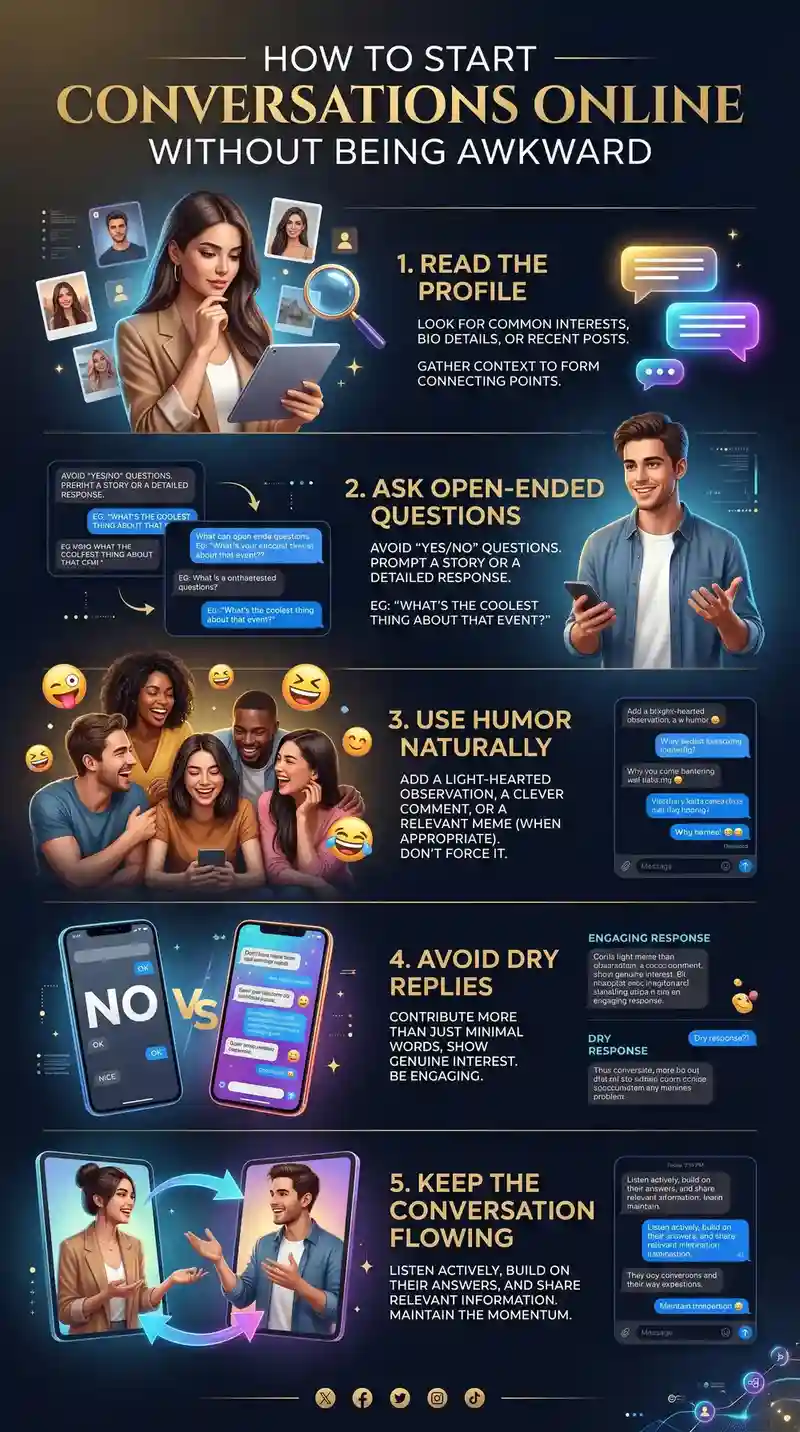
Small talk establishes trust; deeper conversations create genuine connection. The transition requires timing and a light touch — you can't jump from "what's your favorite pizza topping" to "what's your biggest regret" in two messages.
The "Conversational Side Door" Method
Never ask a heavy philosophical question out of nowhere. Instead, use a side door — pivot from a light topic they're already discussing toward a slightly deeper angle on the same subject:
- The Motivation Pivot: "If money genuinely wasn't a factor, what would you spend your days doing?" — natural pivot from any conversation about work or the grind.
- The Advice Check: "What's the best piece of advice you've ever actually followed through on — not just heard?"
- The Perfect Day Scenario: "Describe your absolute perfect day, start to finish. No caveats, no 'realistically' — just what would happen?"
- The Values Question: "What's something you used to believe strongly that you've completely changed your mind on?"
- The Growth Question: "What's one thing you're currently working on — not a goal, just something you're actively trying to get better at?"
- The Regret-Free Version: "If you could go back and give yourself one piece of advice at 16, what would it be?"
Video Chat Specific Openers
Video chat introduces a whole new layer of social pressure — the camera comes on, and suddenly you're performing in real time. These openers specifically address the video-chat context:
- "Okay first things first — what's the most chaotic thing visible in your background right now that you're hoping I won't notice?"
- "We have exactly thirty seconds to decide: are we doing formal introductions or are we just jumping straight into a debate about something? Your choice."
- "I'm going to rate your lighting setup out of ten and I need you to rate mine. Professional only."
Funny & Quirky Starters to Break the Tension
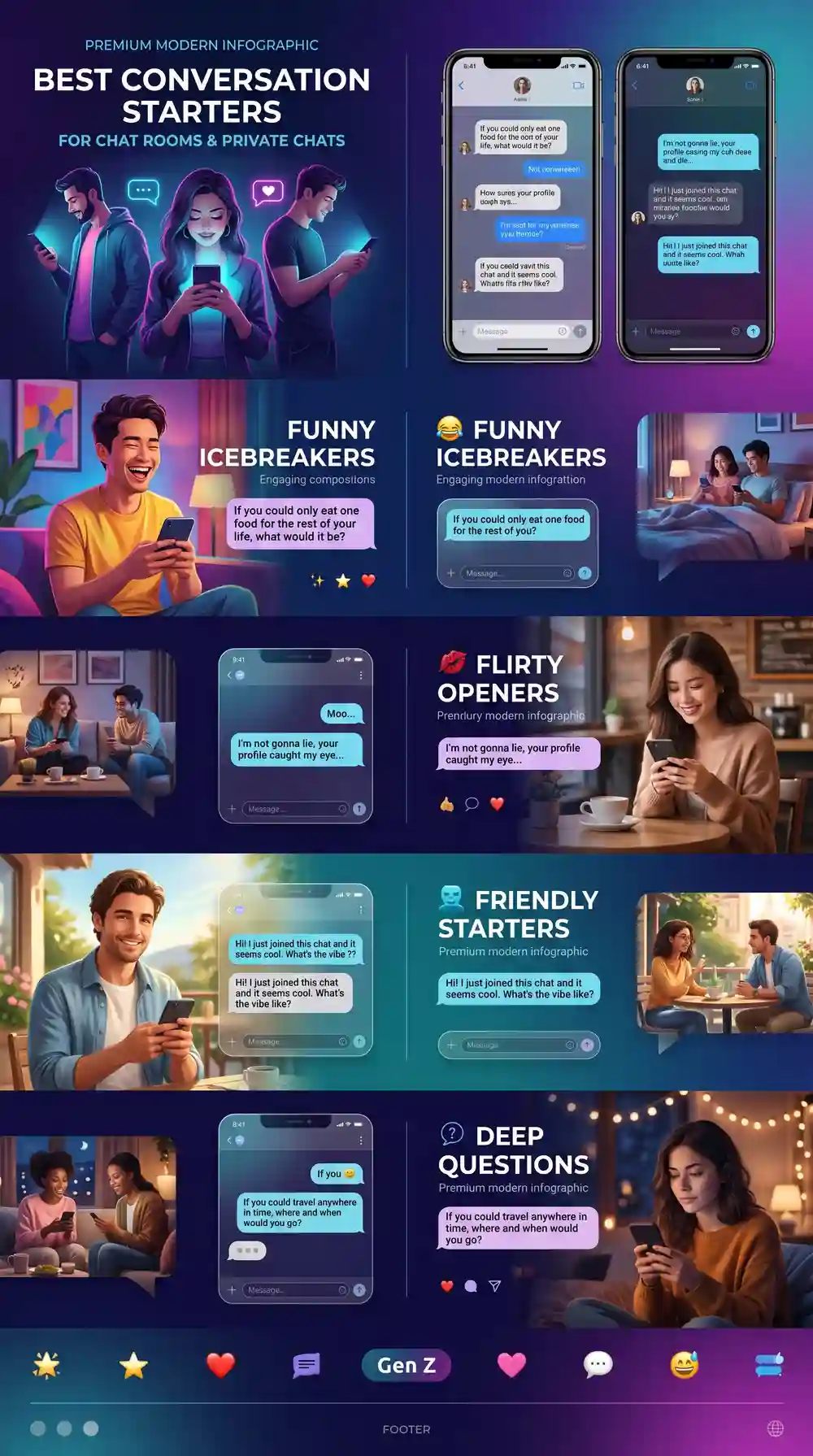
Humor is the fastest trust-builder in text-based communication — but it's also the riskiest. The openers that work best lean on absurdism and self-awareness rather than wit that could read as mean or try-hard.
- "Everyone has one completely useless talent. What's yours? Mine is catching grapes in my mouth from across the room. It's never been useful, not once."
- "If aliens landed right now and you had to show them ONE YouTube video to explain humanity, what are you playing?"
- "What's the most unhinged decision you've made that somehow worked out fine?"
- "I'm going to guess something about you based purely on vibes and I need you to tell me if I'm right. Ready? [Make a specific, slightly absurd guess.]"
- "What's your most niche, unexplainable fear? Mine is escalators that face a wall. I don't know why."
- "Describe your personality using only three movies, one food, and an emoji."
- "What's the most embarrassing thing you still do regularly as an adult that you were told you'd grow out of?"
- "Quick hypothetical: you've been given a budget to build the world's most useless invention. What are you making?"
Many of these openers were developed and tested specifically within anonymous chat environments like Chatib — platforms that emerged as Omegle alternatives after that platform's shutdown. The fast-moving, low-stakes nature of anonymous chat is actually the ideal testing ground for new conversation openers.
How to Restart a Dead Conversation
Not every chat ends cleanly — sometimes a conversation just fades mid-thread, and you want to pick it back up the next day without it being awkward. The wrong approach is a blank "hey" or an apologetic "sorry I disappeared." Both put the burden back on them.
- The Context Callback: Reference something specific from your last conversation. "I kept thinking about what you said about [X] — I finally have a response."
- The New Material Open: "Something happened today that immediately made me think of our conversation. You're going to find this either hilarious or deeply concerning." Then share the thing.
- The Clean Restart: "Okay I've been bad at replying, but I want to fix that. New question: [something fresh and engaging]." Brief, honest, moves forward.
- The Long Gap Humor: "Reporting back from my brief disappearance into the void. [Context of what you were doing.] What did I miss?"
The Graceful Exit: How to End a Chat Well
Not every conversation is meant to become a friendship. Ghosting — disappearing mid-exchange — causes the other person to wonder what they said wrong, which is an unnecessarily bad experience. A clean exit is both kinder and, paradoxically, more memorable.
- The Time Constraint: "This has been genuinely fun, but I have to go finish [thing]. Catch you around the chat later!" Specific and warm.
- The Genuine Close: "I really enjoyed talking to you — I'm logging off for the night." Simple, honest, leaves things on a high note.
- The Future Hook: "I have to jump off, but I want to hear how [thing they mentioned] goes. If you're back around tomorrow, let me know." Leaves a reason to reconnect.
- The Slow Fade Signal: If the conversation has already naturally slowed down, you don't need a formal exit — a slightly longer response time + a "have a good night" with genuine warmth is sufficient.
What NOT to Say: Mistakes to Avoid
Even well-intentioned openers can backfire. These are the patterns that consistently shut down conversations before they start.
The Interrogation Mode
Firing off question after question — even interesting ones — makes the chat feel like an interview. The other person starts to feel evaluated rather than engaged. The Fix: For every question you ask, offer a piece of information about yourself first. Don't make them do all the work of being interesting.
Oversharing and Crossing Boundaries
Asking for real names, exact locations, or personal contact information too early signals either naivety or bad intentions — neither is a good look. For a full breakdown of what to share and when, see our guide to online safety and privacy. According to the Pew Research Center's data on online privacy attitudes, a significant majority of adults feel their personal information is less secure online than it was five years ago — a reflection of why online strangers are appropriately guarded with personal details early in a conversation.
The Double Texting Dilemma
If they haven't replied, sending a follow-up "hello??" or "did I say something wrong?" creates social pressure that almost always guarantees they won't respond. People step away from screens. Silence is not rejection — it's just life. The Fix: Let it breathe. If you're genuinely left on read for days, move on without a trace of bitterness. The chat rooms will still be there.
The Generic Compliment Trap
Leading with "you seem really interesting" or "you have a great vibe" tells the other person nothing except that you noticed they exist. It puts pressure on them to live up to a vague description they didn't ask for. Specificity is the difference between a compliment that means something and one that's indistinguishable from copy-paste.
Quick Reference: Do's & Don'ts
| ✅ Do This | ❌ Avoid This |
|---|---|
| Open with a specific observation or curiosity hook | Send "hi", "hey", "what's up", or "sup" |
| Ask open-ended questions that need more than one word to answer | Ask yes/no questions then wait for them to expand |
| Share something about yourself with every question you ask | Fire questions without offering anything in return |
| Mirror their message length and response pace | Send paragraphs to someone replying in five words |
| Reference something specific they said earlier | Send the same opener to everyone (people can tell) |
| Use a graceful exit when you're done chatting | Ghost mid-conversation without a word |
| Let silence breathe — one unanswered message is fine | Double-text or follow up with "hello??" |
Frequently Asked Questions
Conclusion
The gap between a conversation that dies in two exchanges and one that turns into a two-hour chat isn't personality or luck — it's structure. A specific, open-ended opener that gives the other person something to respond to will outperform a "hey" every single time, on every platform, in every context.
The frameworks in this guide — the Digital FORD technique, conversational threading, digital body language — are designed to be internalized, not memorized verbatim. Use the 75+ starters above as starting points, adapt them to your voice, and test them in real conversations. The only way to develop instinct for this is repetition.
Start with the public chat room openers today on Chatib's free anonymous chat rooms — the fast-moving, low-stakes environment makes it the ideal place to test what resonates before taking anything more personal. And if you want to keep building your conversation skills, our guides on making genuine friends online and staying safe while chatting with strangers are the natural next steps.
Further Reading

Barbara Johnson
Barbara Johnson is a digital writer and social media enthusiast with several years of experience writing about online communication, social platforms, and internet trends. She focuses on helping readers better understand the changing world of online interaction, including chatting platforms, digital communities, privacy, and safe ways to connect with people online. Through her writing, she aims to provide clear, practical, and easy-to-understand information for people exploring modern ways to communicate and meet others online.