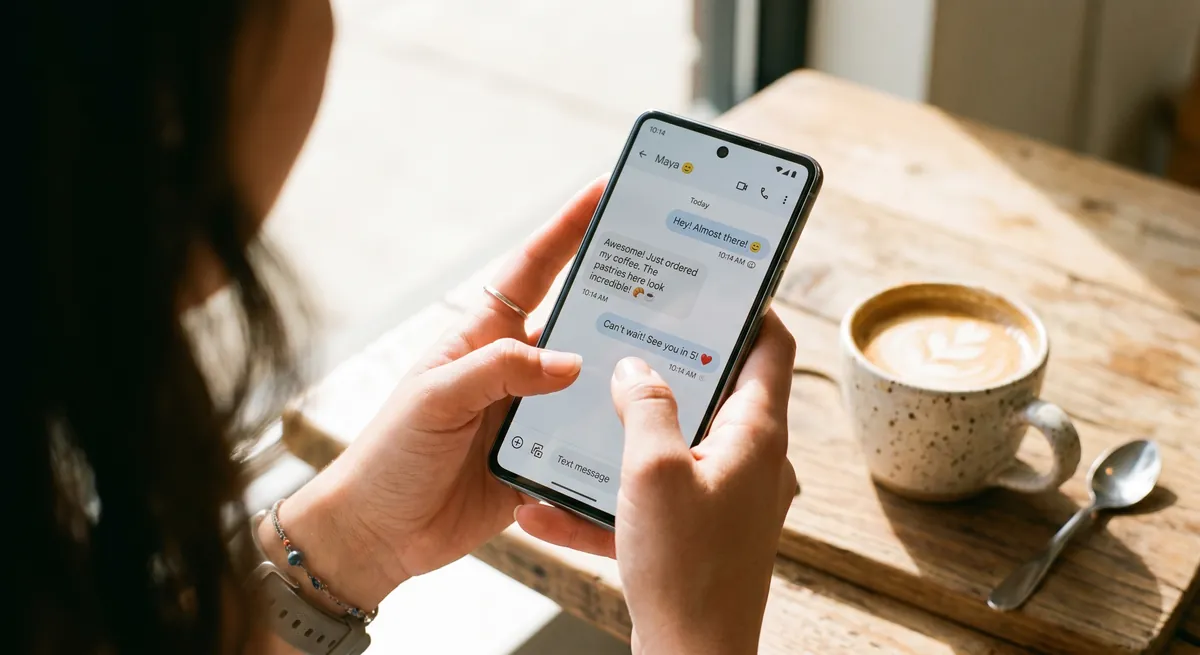
Internet slang and chat abbreviations are short, informal terms used in digital messaging to communicate faster and convey emotion. Common examples include BTW (by the way), TBH (to be honest), GTG (got to go), BSF (best friend), KMS (dramatic frustration expression), LOL (laugh out loud), and NGL (not gonna lie). They save typing effort, inject emotional warmth into plain text, and help maintain the natural pace of a conversation on mobile devices.
- BTW = By the way — adds a casual side note mid-message
- TBH = To be honest — signals vulnerability and openness
- GTG = Got to go — a polite, respectful digital exit
- BSF = Best friend — a badge of deep online trust
- KMS = Dramatic frustration — check in warmly if context is serious
- NGL = Not gonna lie — signals candid honesty
- No cap = No lie / completely true — Gen Z sincerity marker
- Rizz = Natural charm or charisma — the defining Gen Z compliment
- IMO = In my opinion — frames a view as personal, not universal
- IKR = I know, right — instant validation and agreement
Internet slang did not appear overnight. It evolved across four distinct technological eras, each leaving a permanent mark on the way we type today.
Early chat rooms on IRC and AOL Instant Messenger gave birth to ASL, BRB, LOL, and GTG. Slow connections rewarded brevity; every saved character mattered.
SMS character limits and T9 predictive text turned typing into an obstacle course. BTW, TBH, NVM, and TTYL became standard shorthand to stay under 160 characters.
Full keyboards removed the character barrier, but speed norms remained. NGL, TBF, FOMO, and IMO spread globally alongside the rise of emoji as emotional punctuation.
TikTok and Discord created a new layer of slang: Rizz, No Cap, Delulu, Mid, and Brain Rot emerged as cultural identifiers that spread internationally within weeks of creation.
Understanding this timeline helps you place any unfamiliar term in context. Older abbreviations are nearly universal; newer Gen Z terms are more culturally specific and evolve faster.
Our shorthand vocabulary fills gaps that plain text cannot. These acronyms carry emotional weight — signaling warmth, marking a polite exit, or establishing a bond of trust. When learning how to make friends online, understanding these shortcuts helps genuine warmth shine through rather than get lost in ambiguity. Our anonymous chat platform is a comfortable space to put them into practice.
The Psychology of Keyboard Efficiency
Our minds move much faster than our thumbs can type. Shortening phrases bridges the gap between spoken speed and written speed, keeping dialogue lively and preventing the silence that causes conversations to stall. According to linguists, this pattern is called phatic communication — where the primary goal is maintaining a social bond rather than transferring factual content. In a medium prone to text negativity bias (the tendency to read plain text as cold or terse), abbreviations act as emotional punctuation to soften interactions.
Consider what BTW — short for "by the way" — actually signals in practice. Used mid-message, it tells the reader: this next point is low-stakes, stay relaxed. TBH (to be honest), on the other hand, signals the opposite — the sender is dropping their guard and sharing something genuine. These two simple acronyms guide not just the meaning, but the entire emotional register of a message before the key point is even read.
Merriam-Webster has documented the formal entry of several internet-origin terms into the dictionary, including words tracked via their "Words We're Watching" program, reflecting how thoroughly digital shorthand has entered mainstream English.
Real World Digital Etiquette
Without vocal tone, written messages rely on visual signals to communicate volume and warmth. Typing in all capitals reads as shouting; lowercase with casual shortcuts signals a relaxed, approachable sender.
Reactive acronyms like LOL (laugh out loud) and LMAO (laughing my ass off) have evolved beyond literal descriptions of laughter into conversational buffers — a way of signaling that a comment is friendly and should not be taken seriously. Adding JK (just kidding) after a cheeky remark serves the same function as a virtual smile, preventing unintended offense and keeping the tone playful. Here is a quick comparison of tone-shifting terms:
| Term | Stands For | Tone Effect |
|---|---|---|
| LOL | Laugh out loud | Lightens any statement; signals friendliness |
| LMAO | Laughing my ass off | Stronger levity; genuine amusement or absurdity |
| JK | Just kidding | Defuses a potentially serious or sarcastic remark |
| IKR | I know, right? | Validates agreement; creates shared perspective |
| SMH | Shaking my head | Expresses mild disappointment or disbelief |
| ISTG | I swear to God | Emphasizes sincerity or exasperation |
Conversational Traffic Signals
Every conversation needs a clean on-ramp and off-ramp. In person, a shift in posture or a glance at a watch signals that someone is wrapping up. Online, dedicated exit acronyms perform that role — without them, a sudden silence can feel cold or confusing. To build on this with real conversation openers, explore these conversation starters and prompts.
GTG (got to go) is the most universal of these. Sending it tells your partner you value their time and are stepping away for life reasons — not ignoring them. Contrast that with NTG (nothing to give), which draws a quiet personal boundary: the sender has reached their limit and has no further contribution for now. Both are acts of consideration, not rudeness. They make it possible to manage your social energy honestly without causing hurt feelings.
Other key pacing terms include BRB (be right back) for short pauses, TTYL (talk to you later) for longer goodbyes, and AFK (away from keyboard) when stepping back for an undefined stretch.

Everyday Acronyms for Queries and Responses
A large share of daily messaging is purely administrative — coordinating plans, clarifying a point, or confirming agreement. A handful of acronyms handle all of it efficiently, leaving more attention for the actual substance of the conversation.
WRU (where are you) and WDYM (what do you mean) resolve logistical confusion in seconds. NVM (never mind) lets either party discard a topic cleanly when it becomes irrelevant. IKR (I know, right?) delivers instant validation — it tells the other person that their point landed and is completely understood, reinforcing a sense of shared perspective without requiring a full reply.
For moments that call for more nuance, IMO (in my opinion) and IMHO (in my humble opinion) frame a view as personal rather than absolute, which makes disagreement far less likely to land badly. These small qualifiers are the digital equivalent of saying "but that's just me."
Understanding Emotional and High-Intensity Slang Safely
Digital spaces normalize dramatic exaggeration — saying "I am dying" over a funny video, or "I am literally shaking" over mild excitement. This hyperbole is usually harmless, but a few specific terms carry heavier weight and deserve careful reading.
KMS stands for "kill myself." In the vast majority of cases, it is used to express minor frustration in a facetious, dramatic way — "I just tripped over my own feet in public, kms." Even so, the phrase should never be treated as guaranteed sarcasm. If a friend uses it during a quiet conversation about life struggles, take a moment to check in warmly. Offering a supportive message costs almost nothing; ignoring a genuine cry for help costs far more. If you or someone you know may be in real distress, the Crisis Text Line (text HOME to 741741 in the US) provides free, confidential support 24/7.
Similarly, KYS (kill yourself) is occasionally used as harsh dark humour in gaming contexts. Regardless of intent, it is generally considered inappropriate and unwelcome in most chat spaces. Being aware of these terms means you can read the room accurately and respond with the right level of care.
Gen Z Slang in 2025: The Words Defining a Generation
Classic abbreviations like LOL and BRB remain universal, but Gen Z has layered an entirely new vocabulary on top of them. Born on TikTok, Discord servers, and Instagram comment sections, these terms spread globally within days of their creation. Understanding them is no longer optional if you want to communicate fluently with anyone under 30 in an online chat setting.
Unlike traditional acronyms which shorten existing phrases, Gen Z slang often assigns brand-new meanings to ordinary words. Rizz, for example, is not an acronym at all — it is a standalone noun describing natural social magnetism, formally added to major dictionaries in 2023. Delulu compresses "delusional" into a playful, self-aware label. Knowing these terms transforms you from an outsider into a fluent participant in modern digital culture.
| Slang Term | Meaning | Usage Example |
|---|---|---|
| Rizz | Natural charm or charisma | He walked in and already had everyone laughing — serious rizz. |
| No Cap | No lie; completely honest | That was the best pizza I have ever eaten, no cap. |
| Bet | Okay, agreed, sounds good | Meet at six? Bet, I will be there. |
| Lowkey | Somewhat; quietly; secretly | I am lowkey obsessed with that new series. |
| Slay | To perform or look exceptionally well | She absolutely slayed that presentation. |
| Delulu | Delusional (affectionate self-deprecation) | I thought he liked me back. I was so delulu. |
| NGL | Not gonna lie; honest admission | NGL, that movie made me cry a little. |
| Sus | Suspicious or untrustworthy | His excuse sounded really sus to me. |
| W / L | Win / Loss (outcome judgment) | Getting a free upgrade at the hotel was a massive W. |
| FR | For real; genuine agreement | That concert was incredible, fr fr. |
| Mid | Average or mediocre | The food was decent but honestly a bit mid. |
| Brain Rot | Mental fatigue from mindless scrolling | I have spent three hours on TikTok. Pure brain rot. |
| Understood the assignment | Performed exactly as expected or better | Her outfit? She understood the assignment. |
| Rent free | Occupying someone's thoughts constantly | That song is living in my head rent free. |
| Vibe check | Assessment of someone's mood or energy | He failed the vibe check immediately. |
| It's giving | Something strongly evokes a quality or aesthetic | This café is giving 1920s Paris. |
These terms carry cultural weight beyond their surface definitions. When a friend calls something a W, they are not just describing success — they are validating you. When someone says no cap, they are lowering their social guard. Learning to read the emotional subtext of Gen Z slang is what separates passive understanding from genuine fluency.
How to Decode Any Text Abbreviation in 3 Steps
Encountering an unfamiliar abbreviation mid-conversation can be disorienting. Rather than breaking the flow by asking, use this reliable method to decode almost any internet slang with confidence.
Look at the full message and the topic being discussed. The platform matters too — an abbreviation in a gaming Discord carries different weight than the same term in a work Slack channel. Context narrows your interpretation by at least 80 percent before you even search for the term.
Group it into one of four functional categories: reaction terms (LOL, LMAO, OMG), query terms (WRU, WDYM, IDK), exit terms (GTG, BRB, TTYL), or relationship terms (BSF, IDTS, NGL). Each category carries a predictable emotional function that guides your response.
Lowercase abbreviations signal casual warmth. All-caps in isolation often signals sarcasm, irony, or urgency. Multiple exclamation marks push emotional intensity higher. If the tone still feels ambiguous, a direct, friendly question to the sender is always the right move.
Slang Across Platforms: From Web Chats to Mobile Screens
The slang you encounter depends heavily on the platform you are visiting. Structured social media feeds tend toward polished, public-friendly language. In contrast, stepping into a free random chat room exposes you to a faster, rawer style of communication — strangers from around the globe, establishing context and safety boundaries in seconds. If you're exploring different platforms, our roundup of best random chat sites and our list of Omegle alternatives are good places to start.
In these anonymous lobbies, ASL (Age, Sex, Location) remains the universal icebreaker it has been since the 1990s IRC era, cutting through awkward openings instantly. Personal safety is the highest priority in any anonymous environment. Never share your full name, home location, or financial details. For a comprehensive guide on protecting yourself, see our article on privacy and VPN security.
Platform-specific slang worth knowing:
| Platform Type | Common Terms | What They Signal |
|---|---|---|
| Gaming / Discord | GG, EZ, AFK, Noob, Meta | Performance, presence, and skill level |
| TikTok / Reels | FYP, POV, Rizz, Slay, Mid | Cultural identity and trend awareness |
| Anonymous chat rooms | ASL, M/F, Brb, KMS, TTYL | Identity, pacing, and exit signals |
| Dating apps | DTR, Situationship, Ghosting, HMU | Relationship status and intent |
| Twitter / X | IMO, TBH, RT, Thread, Based | Opinion framing and engagement |

Chat Room Safety Protocols and Security Slang
Anonymous communication can be genuinely fun — a clean slate to meet people from distant cultures. But these same spaces attract automated scripts and bad actors. Learning how experienced users filter unwanted interactions keeps your experience safe and enjoyable.
Bots are a common presence in open chat rooms. They typically respond with generic, slightly off-topic messages that do not directly address what you just wrote. If something feels scripted or oddly transactional within the first two messages, that is your signal to move on. Legitimate users engage with what you actually said.
Reputable anonymous chat platforms use M (male) and F (female) identity markers, topic-based room filtering, and reporting tools to keep communities respectful. Prioritize platforms that clearly publish their community guidelines and enforce them. For broader guidance on staying safe online, Internet Matters offers accessible, well-reviewed safety resources for all ages. If a chat moves from text to video, our video chat etiquette and webcam best practices guide covers what to know first.

Master Slang Glossary (50+ Terms)
This expanded quick-reference glossary covers everyday shortcuts, reaction terms, relationship slang, Gen Z originals, and platform-specific signals — everything you need to decode any message that comes your way.
Core Chat Abbreviations
| Acronym | Full Form | Natural Usage Example |
|---|---|---|
| BTW | By The Way | I will be a bit late btw, traffic is slow. |
| TBH | To Be Honest | Tbh I really did not enjoy that movie at all. |
| GTG | Got To Go | My bus is arriving, gtg — speak soon! |
| BRB | Be Right Back | Grabbing a coffee, brb in a minute. |
| AFK | Away From Keyboard | Going for a walk, afk for 20 mins. |
| NVM | Never Mind | Found my keys under the sofa, nvm! |
| NTG | Nothing To Give | I have ntg to add to that — sorry. |
| ASL | Age Sex Location | Hey, asl? Just looking to chat with peers. |
| TTYL | Talk To You Later | Heading to dinner, ttyl! |
| TTYS | Talk To You Soon | Quick errand to run, ttys. |
| IDK | I Don't Know | Idk if he is coming tonight, check with him. |
| IMO | In My Opinion | Imo the first album was better. |
| IMHO | In My Humble Opinion | Imho they made the right call. |
| IKR | I Know, Right? | Ikr, it was so unexpected! |
| WDYM | What Do You Mean? | Wdym you already left? |
| WRU | Where Are You? | Wru? We have been waiting 10 mins. |
| HMU | Hit Me Up | Hmu when you are free this weekend. |
| WYD | What Are You Doing? | Wyd tonight? Thinking of heading out. |
Reaction & Laughter Terms
| Acronym | Full Form | Usage Context |
|---|---|---|
| LOL | Laugh Out Loud | Light laughter; general friendliness buffer |
| LMAO | Laughing My Ass Off | Stronger amusement or genuine absurdity |
| LMFAO | Laughing My F***ing Ass Off | Extreme, over-the-top reaction |
| ROFL | Rolling On the Floor Laughing | Classic hyperbolic laughter (mostly 2000s–2010s) |
| OMG | Oh My God | Surprise, shock, or emphasis |
| SMH | Shaking My Head | Mild disapproval or disbelief |
| JK | Just Kidding | Defuses a sarcastic or cheeky remark |
| ISTG | I Swear To God | Strong emphasis or exasperation |
| KMS | Kill Myself | Dramatic frustration — check in if context is serious |
Relationship & Trust Slang
| Term | Meaning | Example |
|---|---|---|
| BSF | Best friend | She has been my bsf since primary school. |
| IDTS | I Don't Think So | Idts the store closes at nine tonight. |
| NGL | Not Gonna Lie | Ngl, I was nervous the whole time. |
| IYKYK | If You Know, You Know | That ending though. Iykyk. |
| DTR | Define The Relationship | We need to dtr — what are we? |
| Ghosting | Ending contact without explanation | He just stopped replying. Classic ghosting. |
| Left on read | Message seen but not replied to | She left me on read for three days. |
| Situationship | Romantic connection without defined status | We have been in a situationship for months. |
| Simp | Over-investing affection for little return | He texts her every hour. Total simp behavior. |
Gaming & Discord Terms
| Term | Meaning | Context |
|---|---|---|
| GG | Good Game | Post-match sportsmanship signal |
| EZ | Easy | Sometimes taunting; sometimes genuine |
| Noob / Newb | Newcomer or inexperienced player | Descriptive; sometimes teasing |
| Meta | Most effective tactics available | Playing the meta means using the optimal strategy |
| Ratio | Getting more replies/likes than the original post | L + ratio — used to dismiss an opinion online |
| Based | Confidently holding an opinion regardless of others | His take was unpopular but honestly based. |
Using these terms naturally is about matching your conversation partner's pace and register. If they write in rapid, lowercase bursts, shorthand keeps you in sync. If they write in longer, formal sentences, ease off the acronyms and meet them there.
Frequently Asked Questions
Is using internet slang a sign of poor grammar?
Not at all. Digital shorthand is a highly adaptive form of communication that shows emotional intelligence and social awareness. It is a creative extension of language, not a dilution of it — used appropriately in context, it signals fluency rather than laziness.
How can I tell if a friend is using the kms acronym seriously?
Context is everything. If they use it after a minor inconvenience like dropping a pencil, it is almost certainly dramatic exaggeration. If they use it during a quiet, personal conversation about life struggles, take it seriously. Offer a warm, listening ear and, if needed, share the Crisis Text Line (text HOME to 741741 in the US) as a resource.
What are the best safety tips for using a free random chat site?
Always keep personal information private — never share your full name, home location, school, or phone number. If someone makes you uncomfortable, block them immediately and leave the room. Treat these platforms as light, casual spaces. For a deeper guide, read our article on privacy and VPN security. And if you've made a genuine connection that lives far away, see our tips on keeping a long-distance friendship strong.
What does NGL mean in texting?
NGL is short for "not gonna lie." It prefixes a candid or slightly uncomfortable admission, softening honesty with a casual tone. Example: "NGL, I was nervous the whole time." It is closely related to TBH (to be honest) and functions as one of the most common sincerity markers in modern digital conversation.
What does rizz mean and where did it come from?
Rizz describes someone's natural ability to attract or charm others through confident, effortless conversation — essentially social magnetism. The term originated in streaming culture around 2022, exploded globally in 2023, and remains one of the most recognized Gen Z compliments in 2025–2026. It's especially relevant on dating sites and apps, where a confident opener can make all the difference.
What does no cap mean in online conversations?
"No cap" means "no lie" or "I am being completely serious." Saying it at the end of a statement confirms you are not exaggerating. Its opposite, "cap," means a lie or a tall tale. Example: "That was the scariest film I have ever watched, no cap." It is one of the most widely adopted Gen Z sincerity markers across all platforms.
What is ASL in online chatting and is it still used?
ASL stands for Age, Sex, Location — a classic icebreaker that originated in 1990s IRC chat rooms and is still in active use on anonymous and random chat platforms today. It establishes basic context quickly so both users can decide whether to continue the conversation.
What does IMO mean in texting?
IMO is short for "in my opinion." It signals that the following statement is a personal view rather than a fact, making it easier to disagree without it feeling like an attack. IMHO (in my humble opinion) is a softer variant used when the sender wants to sound less confrontational.
What is the difference between LOL and LMAO?
Both express laughter, but with different intensities. LOL (laugh out loud) is a light, general-purpose laughter buffer — often used simply to keep a tone friendly even without genuine amusement. LMAO (laughing my ass off) indicates stronger, more genuine amusement. LMFAO escalates further still.
What does 'ghosting' mean in online chat?
Ghosting means abruptly cutting off all contact with someone without explanation — no reply, no goodbye, no reason given. It is one of the most common causes of social anxiety in modern digital communication, particularly in dating and friendship contexts. Being "left on read" is a milder version of the same behaviour.
How has mobile texting affected human relationships?
It has made us more continuously connected, allowing us to share small, spontaneous moments that would otherwise be lost. While text lacks physical closeness, using warm slang and honest abbreviations allows people to build genuinely deep, trusting relationships across digital spaces.
What does 'left on read' mean?
"Left on read" means someone opened your message (triggering a read receipt) but chose not to respond. It often signals disinterest, avoidance, or simply being too busy — and is a widely recognized source of social anxiety in modern messaging culture.
Internet slang is a living, evolving language layer built on top of standard English. The terms in this guide give you the vocabulary. What makes you truly fluent is understanding the function behind each term — the pacing signal, the sincerity marker, the trust badge, the emergency exit. Use them to communicate with more warmth, more precision, and more awareness of how your words land on a screen. The next unfamiliar abbreviation you encounter is not a barrier — it is an invitation to learn something new about how people connect.
Ready to put your new vocabulary to work?
Jump into a free Chatib chat room and try these terms in a real conversation — no sign-up required.
Start Chatting Free →
Barbara Johnson
Barbara Johnson is a digital writer and social media enthusiast with several years of experience writing about online communication, social platforms, and internet trends. She focuses on helping readers better understand the changing world of online interaction, including chatting platforms, digital communities, privacy, and safe ways to connect with people online. Through her writing, she aims to provide clear, practical, and easy-to-understand information for people exploring modern ways to communicate and meet others online.
Relationship Slang and Building Digital Trust
Once basic communication is established, slang becomes a tool for marking closeness. BSF — best friend (or best sister friend) — is more than a label. Applying it to someone is a deliberate act of trust, communicating that the relationship has reached a depth where real vulnerabilities can be shared. To deepen that trust further, try sharing deep questions to get to know someone. If that connection starts to feel like more than friendship, our guide to flirting tips for online romance can help you navigate the shift.
Honest pushback is equally important. Replying with IDTS (I don't think so) signals that the relationship is secure enough to withstand a differing view — the mark of a genuinely healthy connection rather than a polite, surface-level one. Other relationship-tier terms worth knowing: